

Are you actually the sum of your experiences? (Kant.) Is there actually a zero-sum game when it comes to social interactions and longevity around relationships? Is your life actually the sum of all your choices? (Camus.) Even Aristotle said something to the effect of, ‘character is the sum of repeated actions.’ What he actually said was that your habits make for repetitive and predictable behaviour, but character gives moral equilibria to a life. I wonder if this axiom is reflexive with Einstein’s quote about insanity: “Insanity is doing the same thing over and over and expecting different results.” The sentiment aligns with Adam Smith’s economic philosophy and John Adams’ political ideals that ‘a nation is the sum of its values, not just its wealth.’
What’s the point of all these quotes and interpretations? I’ve been thinking about how I process information recently and how I respond to people in the moment. I deliberately engage my System 2 thinking to override my System 1 instincts over time. Years of experience and countless humbling moments have shaped my perspective. Over the years, I’ve developed my own internal litmus test; a filter, and this filter is in the form of a question. That question assists me in navigating the discourse I either share or have swirl around in my head until it dissipates into the muffled noise:
‘is this evidence or ego?’
As Kant said, a person is the sum of their experiences. There are four main aspects in his thinking:
- We can only take things at face value and we can’t know them for their true selves. I interpret this from a quantum physics perspective of only ever seeing matter as particles and never waves, or vice versa,
- We can have an understanding of something without experience or any second-hand interaction with it. He’s talking about a synthetic a priori,
- We can purposely experience beauty and obtain said beauty through an ordered and natural world. He’s alluding to the fact that beauty can only be seen from a rational point of view and only in low entropy systems, and
- What we understand about ourselves, each other, other beings, and other dimensions can not be explained by science. There are universal known unknowns, and science hasn’t advanced enough for us to understand its depth, hence his agnostic foundations.
Although there’s validity in his existential thinking, this appears to be overly simplistic to me … the dude with an Excel blog … and it reminds me of the other philosophers of the time, like Adam Smith, David Hume, and Christian Wolff. Although these thinkers exhibited recognition for those with diverse backgrounds and needs back during this period, that’s where the buck essentially stopped. Adam Smith was: a proponent of the invisible hand; aware that markets weren’t efficient; governments should be acting as a protector for those in its society; and education was a solution to inequity. Kant and Wolff were proponents of the emphasis behind humanistic duty (of care); people will and should look out for one another, almost devoid of having emotions involved in the argument. Hume, on the other hand, took a specific angle of psychology where people’s morals were based on their sentiments and not just the rational good of will. I argue that Hume uniquely addressed what others did not: the role of informed biases.
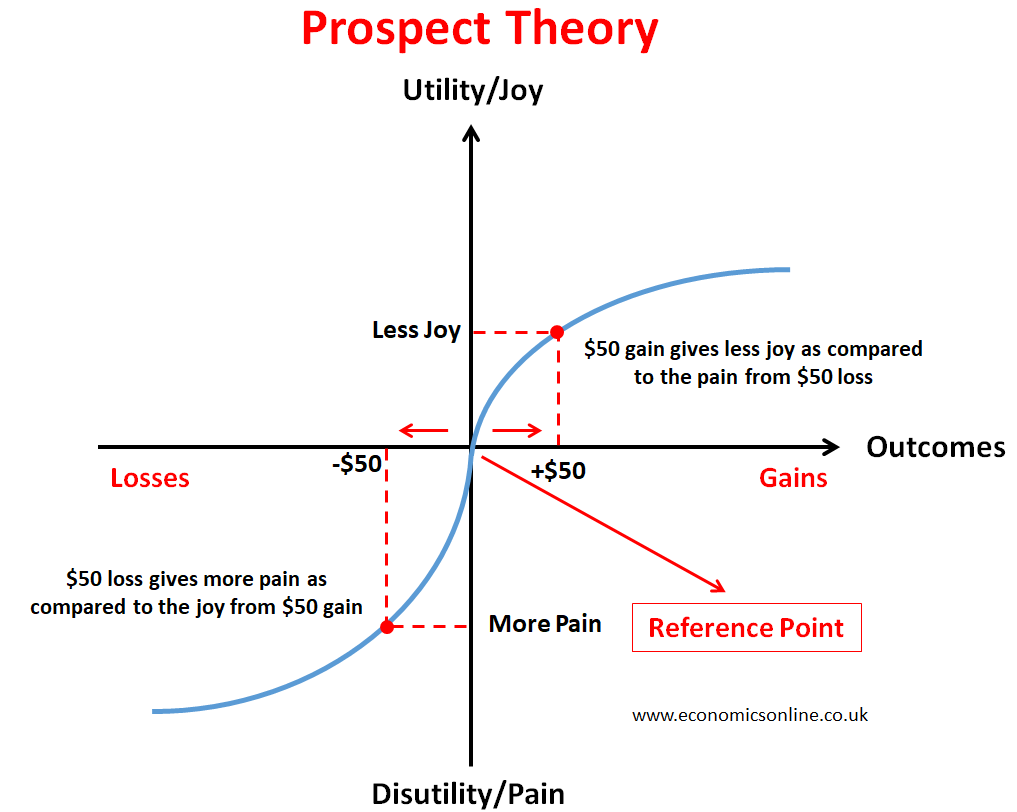
So, when I ask myself, ‘is this evidence or ego?’ I am, in essence, attempting to filter out my biases. I believe my main achilles heels are the availability heuristic, hindsight bias, and to a lesser extent loss aversion. I’ll start with loss aversion; Kahneman and Tversky in 1991 have statistically significant proof that people experience the feelings of their losses greater than the feelings of their wins. Personally, If I won the lottery, I can guarantee you that the feeling of winning would definitely outweigh my feeling of loss, but who am I to argue science? However, since learning the theory behind this science and applying it every day thinking post graduate studies, I approached losses in a much more balanced sense. (I guess my lottery comment makes more sense now.) After you complete an economics degree that contains maths, accounting, finance, and behavioural economics, you should hopefully pick up on the concept of risk and how we might assign a weighted value to that risk. This approach to understanding risk (and potential losses) has provided me with an outcome that yields a flatter and less S-curved shape. I’ve taken these insights of biases and heuristics and applied them to how I think about problems, consider their conditions, and how I can arrive to the solution. I’ve even got some blog posts about this process here and here. Here is my analysis of my metacognitive processes into my thinking.
Given the way heuristics work, I am going to analyse the problem that is directly in front of me first – the shiniest object right in front of me. I get lost in the details right in front of me and begin looking for patterns that might actually result in my skewed perspective. However, it never lasts long as I consciously snap my brain into the shifting lens between the macro and micro; “What am I looking at? Why am I even looking at this? What am I currently attempting to solve? What was my original goal? Did I even have one? What was the original question? What is the data in front of me? What discipline am I thinking this through the lens of? Is this lens correct? Should I put different glasses on? How would it look if I used [insert here] perspective?” Finally, after I turtle my way down below Discworld, I have that tendency towards creeping determinism (hindsight bias). If I do tend towards that way of thinking, I’ll snap myself out of it and start asking myself all of those questions (and more, usually preceded by ‘why’). By doing this, I continue to learn more about what’s in front of me and what my brain is attempting to search for. I’m aware that I will be answering a question that I didn’t originally have, but the fact is that I have a question. Where I take myself from there is back to my original question and review my work, my thinking, and my strategy plan for the next analysis.
With my experiences over the past 10 years, I can firmly say that I am no longer a consistent victim of the anchoring bias. That was an ego trip that took my brain a while to overcome, and of course it will slip into that realm occasionally, but it feels good to strip yourself of something like that. But, this is what I think is important to discuss when we’re talking about the sum of our experiences.
If we view ourselves as that zero-sum (socially, pareto optimal) then the human lens that we have, rife with bias, will create massive weighted averages on one side of that equation. This is a completely generalised statement and doesn’t hold true for all people, however, humans are plagued by the collection of hindsight, recency, negativity (going hand-in-hand with loss aversion), and anchoring biases. It’s that old adage of granting more weight to the negative things that happened in an event rather than the process of getting through it, the methods that were utilised (and changed throughout) in order to achieve the overarching goal.
As I weigh my next words, I ask myself: ‘is this evidence or ego?’. As a fan of the Myers-Briggs Personality Test, I’ve consistently tested as an INFJ (Advocate) – Introverted, Intuitive, Feeling, and Judging since the first time I completed the test in 2006. In short, I am (apparently) a deeply intuitive and empathetic visionary who seeks meaning, fosters deep connections, and strives to inspire positive change while balancing idealism with a complex inner world. If you’re not sure what yours is, take the test, and I strongly recommend that you read the history around how and why the mother-daughter duo came up with the test. I retake the test between every 6 months to a year and my personality type has never changed. Interestingly, I would write the way that I do because I happen to align with this personality type on this test.
When I’m learning something completely new, I approach it from an intuitive perspective first;: ‘This is what I think the issue is, so this could be the solution area I might be looking in.’ I know I may be wrong, but I accept that. I accept that because I’m always ready to learn something new and gain an additional perspective on things. Having a different perspective is nice, but to gain an additional one evokes the idea that I can pull it and the others that I’ve earned out when I need it. In times when it’s necessary or times where it might not be, you just never know what might come from that situation. I use these additional perspectives (and an uptake of knowledge), which I gain over time, as my evidence.
Once I get to unlearn some knowledges and epistemologies that I had previously gathered, I grant myself the privilege of getting into the mindset of this context. I think this is called hyperfocus. You know when you get into the zone (in Music they call it ‘the pocket’) and only do the one thing for hours on end, only to realise that your body is sore and now you feel emotionally sick because you’ve neglected food since sunrise for the course of knowledge? Yeah, that hyperfocus.
This is what I loved about teaching – learning how to balance yourself as a teacher, mentor, advocate, confidant, and safe space holder, alongside maintaining and updating your practices around regulatory norms and changes. This is what I loved about IT – you get to understand how programmers think and how (and why) it does/doesn’t land in the hands of its intended user. I got to learn where stakeholder management broke down and why. I saw firsthand why effective communication is crucial, particularly when grappling with unfamiliar industry concepts. 2 people in a conversation together could accidentally be talking about 3 different simultaneous things. This is what I love about data analytics – the same data (which later becomes information) can be interpreted differently based on the hands that it’s in. I’m still early on in my journey of that world, but I believe what sets me apart is my mind and the way it considers facts (looking for the truth between the numbers and how they could be connected from another perspective), possess a drive to correct any misunderstanding I have of something along the way, finding beauty and appreciating it for its high- or low-entropy state because it exists for its reason, and a life-long learner who thrives in the unknown and a willingness to expand my zone of proximal development. This is what I love about contextual epistemologies – much of what I intuitively thought would turn into my ‘this is what I used to think’.
When I reflect on my real-time responses to others, I recognise my thoughts filtering through both System 1 and System 2 cognition. I have the questions bouncing off one another. I attempt to be aware of my biases, and before I release that statement, I ask myself:
‘is this evidence or ego?’
 James Miller CV
3 responses to “86 – Summing It All Up”
[…] the history of projections. What you’re seeing is a self-constructed sunk cost fallacy system; add this bias back to the list. I fell into this fallacy through the fact that I had spent time setting it up and it….worked. […]
[…] growing over last year was, ‘I must have done something to make these numbers boost.’ Due to my recency/availability biases, I was attempting to wrap my head around the idea of publishing only 11 posts at the beginning of […]
[…] types. One of my favourite personality tests is the Myers-Briggs, which I’ve spoken about in a recent post. It just so happens that the people I used in this previous post, I actually have their personality […]