

Goal setting, hey. It’s a hard thing to create, but even harder to play out and actually achieve what you had intended. I believe there are a multitude of reasons why people struggle with this, one of which being the fear of failure. (Here’s a talk by a personal hero of mine, Rodney Mullen, if you’re interested in how the creator of modern day street skating views failure.) Something that I’ve learned to be really comfortable throughout life is the idea of ‘failure’. From my experience with the concept and discussing it with people, so many are quick to stop me in my tracks and jump onto the idea of reframing failure into aspects of the event/task/activity that worked. I’m assuming this is to soften the blow of what one didn’t achieve. But, my brain doesn’t think about it like that.
Growing up, I was very self-encouraging with trial and error. Iterations. Planning, attempting, addressing issues, reattempting, recalibrating. I grew up skateboarding and rollerblading. I grew up playing with Hot Wheels (cars and tracks). I grew up learning how to play guitar. I grew up on a trampoline and used to write and film ‘running films’, which I found out was created a few years later and was dubbed ‘parkour’.
I don’t believe that the idea of failure should be viewed as a loss. It’s something to view an opportunity, with help of one of my favourite questions – why? Why didn’t it work? What aspect(s) caused this outcome and why did that happen? What sequence of events occurred and why? Why didn’t I think of that consequence in my planning?
When you play guitar or skateboard, you’re constantly interacting with the concept of failure from day one. The amount of failure that you need to overcome before you hear or feel a successful result is astounding. I’m one of those people who needs to process something a few times before it really sticks. But, once I have cemented that pattern (or process), it’s in my brain for good. I accepted that fact years ago and have subsequently provided myself the space to learn, knowing that I will most probably need that additional time. And, if not, bonus! That’s bonus time that I’ve just earned back. (In a similar vein as ‘bonus fries’; the fallacy where someone perceives they’re received more chips (French fries) in their takeaway bag due to the fact that they’ve fallen out of the chip container whilst already in the bag. …don’t even get me started. Five Guys have included this value-add, bonus fry approach when serving customers, but I think it’s safe to assume that this approach is already included in the selling price.)
This post is about my reflection on the past year at work, and how I’ve allowed it to contribute to my perpetual learning journey or idea creations. At the beginning of 2024, I outlined some goals that I set in place. I’d be a walking contradiction if I didn’t bring these goals back and truly reflect on them. So, I’ve copied my specified goals from this post and added annotations for the reflections. These annotations include blog posts that I made during the year that were somehow related to the work that I was performing.
Goal 1: Continue to be a Generalist
‘Learn various arms of the organisation and actively & appropriately contribute, where necessary.’
My role as an Admissions and Placement Officer at Teach For Australia requires me to interact with people at various touch points along the pipeline. This role requires me to facilitate Candidates with varying needs across the year, including communicating with them prior and during application submissions, assessing these applications, assessing their academic transcripts for the learning areas, assisting in preparing the administrative side of Centres, assessing Candidates at Assessment Centres, performing Tech Guidance at those Centres, performing currency checks for Candidates, and welcoming Incoming Associates to the program. All of these points along the way, although interconnected, require differing levels of processes, sequences, and logic to manage the pipeline. With my background as a generalist, I thoroughly enjoyed learning all of the different facets and documented the As-Is and To-Be (post coming soon) processes within the organisation. Below in my other goals are a subset of the contibutions that I made to the organisation throughout the year.
Receiving Recognition
At Teach For Australia, they govern themselves by 5 core values: serving the students, having high expectations, making it happen, getting there together, and celebrating along the way. I was able to finish off the year with my direct manager, and CEO of the organisation, recognising my contributions to them through the value of ‘getting there together’. I place great weight on this value, and see it as a true honour to accept the award for it. As a generalist, I see the strength in working with people for the greater goal as opposed to working siloed or breaking information up between people and departments. Being able to cross over between these people and areas makes for opportunities for innovation to be observed.
Goal 2: Introduce data processes into the job
‘Introduce some six-sigma/lean methodology into aspects of the role, e.g., analysing Candidate university transcripts.’
Although there are org-specific details that I can’t divulge into in this space, I hit my documentation processes quite strongly from a process perspective. I approached a lot of my work from the perspective of ‘how can I document what I do and how much of it can be done electronically?’ I wanted to make sure that much of what I was doing could be automated and prescribed ways (and analysis) for how it could be automated. From this work approach, I ended up creating these posts as inspiration (or revamped before doing this kind of material at work).
As part of my role, and to contribute to the greater good of my team (and the org), I was asked to map out some wider-org processes after producing hand-over documentation for a colleague. I was able to map processes, create documentation for those processes (and sub-processes), whilst highlighting inefficiencies that were requiring people a lot of processing time. With this inspiration from work, I decided to create (and you will see posts in the series after this current blog post) a series of how to work through a Business Process Management case.

I was interested in different aspects of Marketing and Candidate behaviours, so I also considered conditional probability a fair bit for the first half of 2024. That led me to creating this post as I find it pretty interesting, but also was curious as to how I could actually use it in my “day-to-day” work. I used the perspective of the main portion of this post for marketing conditional probability and the potential gains that a business can yield. It provided me the ability to flex this maths segment of my brain whilst heavily in the qualitative portion of my work.

Almost used as a way to analyse the effectiveness of that conditional probability calculations, I used some ARMA (SARIMA) models to track Candidate behaviour, but also forecasting potential engagement throughout the year.

Tangentially, I play basketball in my local community (we finally won the Championship, I might add), and I was interested in our progression throughout the year. I ended up building a Basketball Prediction calculator, based on the Poisson distribution, that ended up being quite accurate for the first half of the season, but ended up becoming blown out as if I was unable to accurately forecast scores towards the end due to the average scores being impacted by outliers. Upon reflection, I would integrate some lower level data analytics and begin analysing player-level statistics into the forecast. The main factor underlying this approach is the inconsistency of those entering scores and sometimes the lack of accuracy around basket values and players.


This one was a bit of fun, where I was able to introduce this logic puzzle to a coworker. We had a few minutes to wait for something to happen, so I showed them this puzzle for their child (who is seemingly a bit of a prodigy when it comes to maths, puzzles, chess, etc). Whilst showing them how to solve Nonograms, I had a lot of fun explaining the different ways that I would go about solving them and didn’t actually realise that the techniques and strategies that I was using (not just brute forcing) were legitimate strategies and had names. In my true form, and in a similar vein to my ChatGPT problem solving series (post 1 and post 2), I outlined some of the potential strategies that one can use when solving Nonograms and wrote down a metacognitive approach to solving these problems.
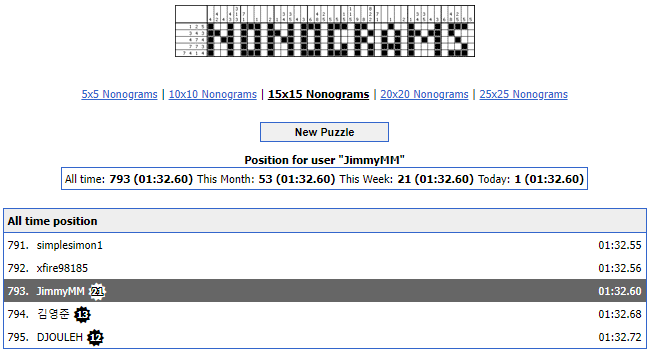
- Post to be released on 27/01/2025
There is actually a post coming out at the end of this month that is inspired by the work that I participate in on a daily basis. This post dives into different statistical methods to understand different transformations for insights; Regression Discontinuity Design. It is essentially a method for understanding how good a piece of assessment is or how someone measured against others within this assessment. If this interests you, here is a link for additional information that you can read.
Goal 3: Integrating more SQL, Python, and Excel (potentially worksheets that others can use)
‘Create my own reports and analysis using processes and methods I already use throughout my data analyst journey.’
I started to generate my own reports and dashboards in Salesforce. It had been a while since I had used it and felt so much more comfortable playing around with it (after 10 years) as I had learned so much about relational databases, primary and foreign keys, and the logical ways to combine various sources of information. However, I wasn’t able to specifically use any SQL or much Python in my day-to-day work, but I did use Excel quite a bit.
Throughout the course of the year, I was gradually made responsible for managing the timetabling Assessment Centres Assessors and external stakeholder speakers. I created the following posts for various use cases within the organisation. I speak to it in this post, but being responsible for assigning Assessors, I would notice that a few would change their availability at any one time, and with the way we were logging them, I wouldn’t know which names had been removed/replaced on the sheets. So, I created this spreadsheet to locate the exchanging names (although not a direct 1-to-1 substitution), making it easier and much quicker for the person to manage the swaps.

Although we didn’t explicitly test for collusion during our work, the idea came to my mind fairly regularly, especially when my colleagues and I had conversations regarding integrity. I would often consider how easy it might be for people to collude in some situations at any point throughout the process; but also consider how silly that is because that approach literally sets you up for personal and unsustainable practices. As it had been some time since I had played around with statistical theory, I created this post to test for colluding individuals. It felt like a fun and creative way to check and monitor for people who might be colluding during assessment, with statistical significance.

Again, as I was responsible for engaging external stakeholder speakers, I got over writing individual emails, so I created the bulk emailing process in Excel. I would organise the speakers by dates, auto load their names and emails, and include all of the necessary people for the day. Once I had the sheet setup, I just needed to add additional dates to the bottom of a list (as they appeared) and selected the date in one cell then all of the information would automatically appear for me. This saved me a lot of cumulative time and created it in about 15 minutes.

- Data and Economic Analysis (unable to share publicly)
There was a piece of work that I contributed to in one of my jobs where I provided analytics and insights into efficacy for a good portion of the pipeline. This work required me to extract and combine data from multiple different datasets then analyse it. I chose an Autoregressive model to uncover insights as it was time-series based, but didn’t actually exhibit a moving average (statistically speaking).
After an initial linear and multi-degree polynomial regression didn’t provide an accurate R2 value (given the change over time), I created a Python script that collated the data, looked for stationarity (and fixed where necessary), iterated over the various p,d,q (ARIMA) values, then looked at the marginal changes over time of various rates. The Python script was straight forward, but output information that would be necessary to someone on any level of analysis: SARIMAX results table; forecasted values (as a set) for the next 20 realised events; a graph depicting the realised, predicted, and forecasted values; a graph showing the SARIMA residuals; and an autocorrelation graph.
These marginal changes were analysed using Excel/Google Sheets for the purpose of showing these values, trends, and comparisons for, again, anyone on any level. The various graphs depicted necessary and sufficient information: 1. engagement, 2. engagement and successful engagement, 3. comparison of 1 & 2 overlapped, and 4. the trend comparison in 3. The flow and combination of this information assisted in telling the story of engagement throughout the year.
Goal 4: Attending to reconciliation
‘See what reconciliation looks like in a professional setting, and bring my own unique understanding (based on my living history) of reconciliation into the workplace.’
The crux of reconciliation is strengthening relationships between Aboriginal and Torres Strait Islander peoples and non-Indigenous peoples, for the benefit of all Australians. This doesn’t mean tapping into the culture to appreciate it. It means to truly listen. Give back. Take on ways of learning. Disseminate that information. But, more pointedly, spread the truth that dispel myths that have been created and embedded in society since 1788.
Throughout time and within our Western system of governance, rules and laws have been set in place to “maintain” the ideas of managing cultures. We even have these places in our legislative system where we define Aboriginality; an Aboriginal person is someone who:
- is of Aboriginal descent,
- identifies as Aboriginal within their community,
- is accepted by their community as an Aboriginal person (Gardiner-Garden, 2000).
Even though we put these systems into place, we still see such a disregard and friction around Indigenous cultures and how to integrate them into “our” society. What’s easier though: welcoming, assimilating those into ours, or learning another system of knowledge? Why still the friction? Western cultures learn by passing stories down to our younger generations, especially stories that are anecdotal and we place a lot of emphasis on either those stories being “true” or the meanings behind these stories and characters to provide a path for our own characters to evolve.
Part of this cultural understanding journey for me, especially in the Tasmanian context, is to discover, understand, and celebrate the culture that was, is, and will/can be. I took active steps over this year to discover more about the history, where available, of the Indigenous peoples on the land I live. That being said, the Tasmanian knowledge around First Nation peoples is extremely complex.
The information that is available, after some deep internet searching and collation, is primarily from a white settler perspective. These writers were people who would travel around and record their learnings from the Indigenous people, especially around names, words, and ceremonies. If you’re familiar with the Tasmanian context, it’s not very clear cut. The concept of palawa in itself is rife with controversy.
However, we have amazing organisations who are on the journey of truth finding and information updates around First Nations cultures. The Orb, wukalina walk, and the Tasmanian Aboriginal Centre are fantastic resources for those interested in learning many thousands of years of indigenous knowledges. Another fantastic resource are people themselves — reaching out to elders in the community.
If you’re familiar with the history in Tasmania, then this passage from the Australian Law Reform Commission report rings more true, and provides more reasons as to why is necessary to fund these types of resources and gather and reconnect original stories:
‘36.39 Some Tasmanian people who identify as Aboriginal, and are acknowledged as such by the relevant Aboriginal community, nevertheless may have difficulty obtaining documentary evidence of their Aboriginal descent. This is due to inadequate colonial record keeping, past policies of removal and other consequences of the historical discrimination against Aboriginal people. These persons assert that self-identification and community acceptance should be sufficient evidence of their Aboriginality for legal purposes. On the other hand, it has been argued that requiring proof of descent is one way to protect against fraudulent or inappropriate claims of Aboriginality by non-Indigenous persons for personal or financial reasons.’
Gathering from various resources throughout the year, I widened my knowledge base of the (specifically) local past to understand the countries that I navigate through and the various cultures that would reside on them for their various reasons throughout the year. Like all knowledge, this is a perpetual updating and honing process for me as it provides me space to deeply connect with the ideologies of those that came before. During times at work, we would open the floor for people to engage in Acknowledgements of Country. I would reflect on the Country I was on (and would travel through), learn about the histories and stories of the local (palawa) people, and meld them into different types of Acknowledgements.
Goal 5: Continuing my quest for educational inequity (in any form that I can)
‘All of my assessment and selection decisions are guided by the aim of targeting educational inequity around Australia.’
This was an interesting one, like goal 4, because I really wasn’t sure how this would look like in the org. I was so pleasantly surprised twice — once when I started work (early January) and again in mid-August when I got to meet everyone in-person. I realised just how strongly aligned everyone that I work with is to making educational inequity more equitable for young people in Australia. I can honestly say, especially during Assessment Centres, that everyone who was assessing did so from the perspective of targeting educational inequity and looking for the explicit and implicit qualities that make the TFA Associates so unique and special for young people in the communities that the organisation places them.
I was also continuing my quest through my continued involvement in Young Engagement for those in the communities around us, including overseeing young people during swimming events, DJing at a community event by young people for young people, and passing on knowledge around sustainability.

Rockin’ in the free world to:
- Macarena: https://drive.google.com/file/d/1HNd5HgkvVQgV62ryVirxzZFdj_aTIt27/view?usp=drive_link
- YMCA: https://drive.google.com/file/d/1G7G_Jrdxx5VcNWcdKFso7lU024OU9HEF/view?usp=drive_link
I hosted numerous training sessions for the Young Outreach Program Managers to educate them around efficient ways to obtain, track, monitor, and improve on their data practices. This had flow-on effects for their budgeting and insights into opportunity costs. This especially became valuable for an evaluation that they had to present at the end of their 2-year program, which resulted in them receiving $40,000 in funding for an additional 6 months of the program.
The ultimate idea with this would be to hand over leadership to the young people in the community. How can they take over? How can they manage? How can they understand the needs of one another in the community? How can they pass on leadership to those around them? How can this leadership, observed from outside of school, impact them all inside the school, from grades (primarily) 10, but 12, down through to pre-school? These are the factors that I really care about, along with all of the amazing people that I work with, and we are attempting to engage young people in the way that they can see this in themselves.
How have your goals progressed over this year? Did you set any last year? Any updates or progress changes?
 James Miller CV
2 responses to “79 – One Year Anniversary at Work”
[…] the beginning of this year, a reflective post outlined what my first year at TFA included. Sure, it was only skimming the surface, but it really […]
[…] approximation has already given me about 15 minutes back, as I’m now short of a 2 hour drive. Always a bonus to get some time back! My intention here is to demonstrate the distance I travel at the legal speed across various parts […]