

Whilst we were at our supermarket’s check out, my wife was telling me about a cast member of The Real Housewives of Beverly Hills, Dana Wilkey, who had a $1M lollipop holder. Essentially, a lollipop holder encrusted with diamonds.

I couldn’t resist and invited the check-out person into the conversation by asking them the classic question, “what would you do if you had $1M?” They responded with, “well, I would buy something better than that.”
I took a shower shortly after getting home and the question floated back into my head:
What would you do if you had $1M?
My head immediately went down that Diderot effect route of buying a house, car, killer networking system with servers, etc (shout out to Linus Tech Tips), etc. After getting that out of my system, with the gentle reminder that $1M can’t sustainably buy you all of that (shout out to all of the renters on MTV Cribs and Redman, for keeping it real), I landed on the idea of a life coach. Bingo!
When I say ‘life coach’ I mean specifically professional life coach. Over the past few weeks, I’ve been attempting to mind my child as much as possible for two reasons: 1) provide my partner more space so that she can take more of a chance to rest from a massive year, and 2) spend a longer period of quality bonding time with my child. Being just over a year now, I’ve really observed how much she can comprehend and engage with the world; this has grown (seemingly exponentially) over the past 5 months. During this time, it’s been nice to be away from a screen/laptop/phone. To be fair, I barely use any of them, except for work. But, this dramatic drop in screen time (40 hours a week) has been another breath of reflective air.
I’ve been considering the two big factors over several months, but feel like proximity blindness has prevented me from updating my resume and portfolio website. What I’m not happy with on both fronts are:
- Resume – reads like a list of tasks that I have completed rather than positioning myself as the professional I know myself to be and demonstrate my desire to grow through both strengths and weaknesses, and
- Portfolio website – a bunch of ad-hoc processes that highlight a wide range of small portions of knowledge rather than provided a small number of projects that have an end-to-end demonstration:
- a summary, the business problem, the chosen methodology for the project, demonstration of required skills, results & business recommendation, and next steps.
Sitting with the research for a while, I came to the conclusion there are various different ways to present your work. This makes sense because you need to consider the target audience, the application field, generalised requirements within analytics, etc. Throughout this reflection, one thing became uncomfortably clear: a portfolio is not a faithful representation of your career, but a presentation to showcase your skills and how you think.
Portfolio: The Issues
My portfolio currently suffers from fragmentation. Although I would argue that I show curiosity, technical breadth, and analytical thinking, it doesn’t strongly highlight how I could make a decision change for the better if I was in the room.
I’ve been considering some thought experiments recently whilst assisting my little one (back) to sleep. One of the recurring thoughts has been answering, ‘what’s your greatest fear/weakness?’ I now feel comfortable with the answer of ‘assuming everyone in the room knows more than me.’ Although I’ve always been comfortable with this idea, I’m not pushing through this barrier, which prevents me from speaking out aloud through the gamut of ideas, problems, pain points, and solutions that I can see or would like to brainstorm. As someone who enjoys efficiency, I don’t like the idea of wasting peoples’ time, but I also don’t leverage my in-built understanding that everyone brings something unique to all situations.
Why Am I Changing My Portfolio?
A recurring theme across portfolio advice (especially from practitioners, not institutions) is that portfolios are no longer about proving you can analyse data. They exist to prove your ability to frame, prioritise, and recommend solutions or decisions under constraints.
The reason that this is a current growth point is due to the fact that analytics tools are becoming easier to navigate, different AI models are lowering the barrier for its users, and decision quality is becoming the bottleneck. I’ve spoken to people in the past about the risk of my job due to AI. Yes, some jobs are going to be at risk, but something that AI can’t take is the way that I think. When I went to university, I didn’t invest in my job prospects. I invested in the way that I think and understanding how others process information. This is why I remain critical of new and emerging technologies, rather than fearful of them.
Given this shift in the market, this means that there is a deprioritisation of portfolios focusing on exploratory wandering, technical walkthroughs, or “look what I learned”.
Restructuring
Yes, I will be continuing to create new projects, but I’ll also rebuild my previous portfolios around decision pathways, not topics. I have chosen these three specific lanes in this restructure:
- Business & Financial Decisions
- Forecasting,
- ROI,
- Trade-offs,
- Scenario analysis
- Process & Operations Analytics
- Throughput,
- Automation impact,
- Error reduction,
- Fairness
- Technical Deep Dives with Use Cases
- SQL,
- Excel modelling,
- Python pipelines.
This approach provides different audiences to self-select into the pathway that they are interested in observing and assessing my fit. In this way, recruiters get reassurance, hiring managers get relevance, and other analysts get depth.
Generalised Structure
At this point, I have created a general structure for each project where any reader will be able to clearly observe and navigate to the area of interest:
- Executive Summary
- Allows immediate context, key insight, and the recommended action without requiring technical depth. ‘Who is the decision-maker?’
- Business Problem
- Defines the decision being made, the stakeholder(s) affected, and the constraints that shape what a “good” outcome looks like. ‘What is constrained?’
- Methodology
- Justifies the analytical approach taken so the reader understands why this method was appropriate, not just what was done. ‘Why this method?’
- Skills
- Explicitly surfaces the transferable capabilities demonstrated, allowing different audiences to quickly assess relevance to their needs.
- Results & Business Recommendation
- Translates analysis into impact by connecting findings directly to a clear, defensible course of action. ‘What changed because of the analysis? What should happen next? What breaks if this scales?’
- Next Steps
- Shows forward-thinking judgment by acknowledging limitations, scalability considerations, and how the analysis would evolve in a real environment.
Using my current website as an example, this is the only information that someone has to use when assessing my work. It assumes too much of the person and potentially leaves them in the dust, needing to connect too many dots:

Source: https://jamesmillercv.com/portfolio/data-analysis-projects/
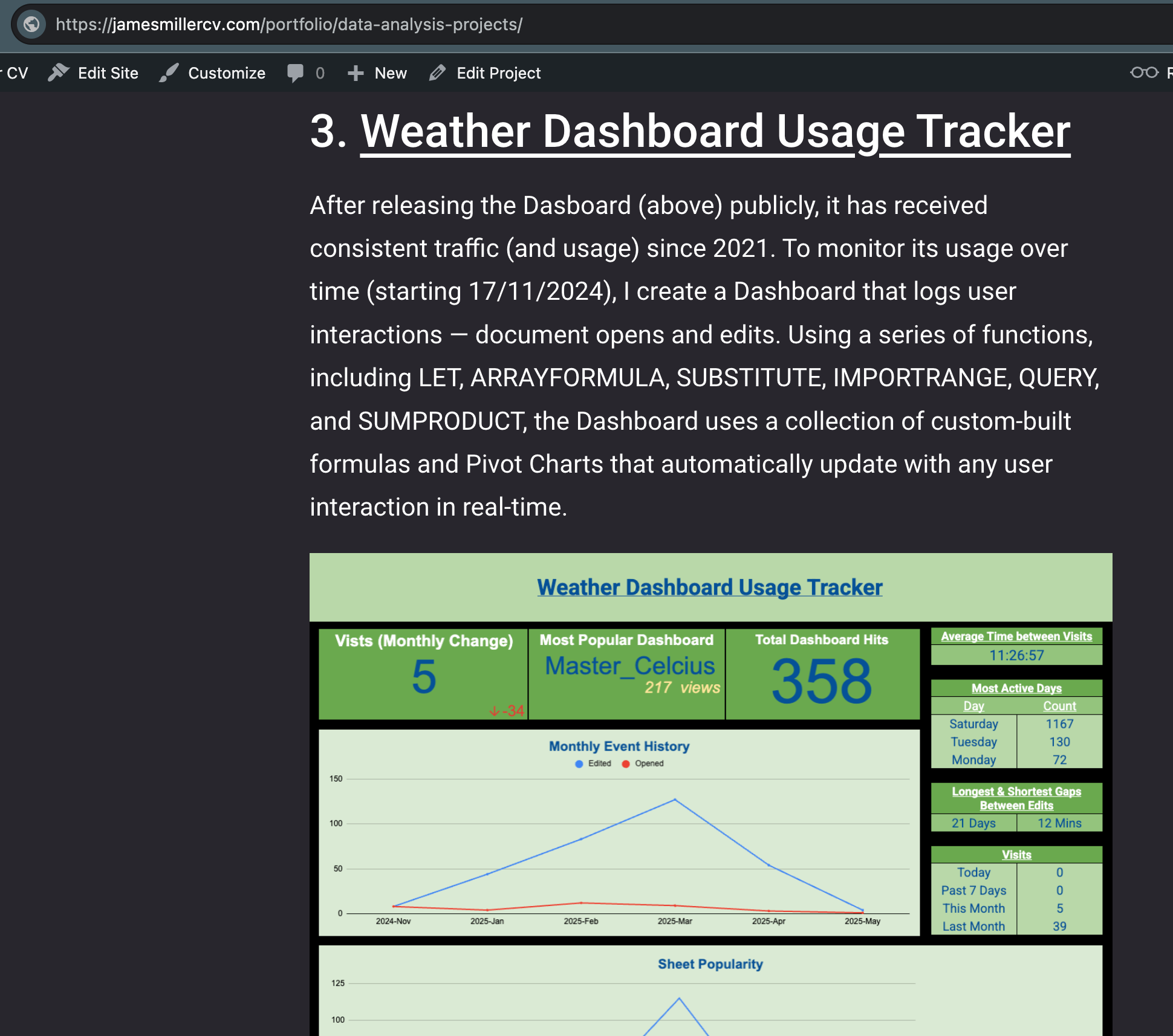
Source: https://jamesmillercv.com/portfolio/data-analysis-projects/
As always, I’m keen to see what the road ahead brings. I’ve enjoyed this past few weeks of reflection as I begin to feel a bit more normal and stable whilst focusing on one major project at a time. This has been a project that I’ve been considering to complete for a while and had even commenced last year, but found myself way too emotionally exhausted to actually start. I developed a plan of attack; breaking that mountain down into molehills. I created SMART goals. I started off on that track. But my brain was prioritising good mental health. This is the time where information needs to be flushed through my brain, overexhaustion of 24/7 decision-making needs to be replenished, and space is forced to be crafted between what I want to achieve and how I actually achieve it.
Is there something that you’ve needed to step away from to focus your proximity blindness? Is there a resolution that you’ve set yourself for this year? Do your resolutions come to you later in the year? I’d love to hear what’s going on in your brain!
 James Miller CV