

I want to start with a thought activity. I’m not asking you for your responses in the comments section below, but I am asking you to genuinely consider these questions and even write down your answers as you go.
First question: Do you know your hourly wage? If so, feel free to write it down then skip down to the next paragraph. If not, you can do a rough estimate; how much do you get paid a year? All up — consider all of your jobs, if you have multiple. Times that number by 2% and that should roughly be your weekly wage. See note for calculation reasoning. Times that number by 20% and that will be your daily wage; 5 days in a week, so split your wage across those 5 days. How many times does 8 fit into that number (or, divide that number by 8)? That’s your hourly rate.
As an example for someone earning $50,000:
Weekly wage = $50,000*.02 = $1,000
Daily wage = $1,000*.2 = $200
Hourly wage = $200/8 = $25
Note: 2% because there are 50 weeks in a generalised corporate year and Total Wage / Total Weeks = weekly wage. If we divided Total Wage by 5, that would be 20%. By increasing the denominator by an additional 0, we are decreasing the time frame we want to calculate the wage. So, instead of looking at the year in 2.4 chunks, let’s look at it in the number of weeks, 50. So, instead of dividing by 5, it is dividing by 50. This is the equivalent of multiplying the Total Wage by 2% => x/5 ⇔ x*.2. So, x/50 ⇔ x*.02.
Second question: How much do you think you’re worth per hour? Go ahead, write it down.
Third question: What is the difference between what you think that you’re worth per hour and what you are paid per hour? That’s the additional value that you perceive your time to be worth (assuming your perceived value is greater than your current market value).
We’re now going to use these numbers in an example. Let’s say that I earn $50,000 per year, but I think that I’m worth $100,000 per year. This means I believe that I’m worth $50 per hour. What I think I’m worth minus what I’m worth is $50 – $25 = $25 additional dollars per hour.
Now that we have these bits of information, let’s say that I’m getting paid that $50 per hour rate, but I need to drive an hour to my next client meeting. As I’m driving, I consider how I’m feeling and I want to get a coffee beforehand to perk me up a bit. To get the coffee and have the meeting start on time, I need to speed up to get to the cafe, order my coffee, and get to the meeting on time. I’m on the highway doing 100km/hr (the legal limit), so I decide to speed up to 120km/hr. Surely that’ll give me enough time. I know that this act runs a risk of me getting a ticket, but I need to make sure that I give myself enough time for coffee too.
Here’s my next question: is this rational? Can you tell me another approach that I could have taken? More importantly, can you prove to me why this is either rational or not?
I’m going to go ahead and say that this act is irrational for any individual, with two conditions: your hourly rate and the Australian State/Territory that you commit the offence in. Obviously, unsafe driving yields unsafe results, but we’re going to assume ceteris paribus here. For the time being, I’m not going to take into account the different types of profiles that people possess, categorising them into either risk averse, risk neutral, or risk-seeking, but we could and delve deeper into this analysis by inferring what the impact these characteristics have when rationalising their responses to this thought experiment. With that said, this profiling and pool-building carries with it many assumptions, especially around intuition versus the nature/nurture element of each individual person.
With these exercises below, I’m going to prove why I believe that speeding is an irrational act.
Exercises
Exercise 1
Let’s assume that I want to travel 20km, and I want to do it at 80km/hr. We can use the Travel Sheet on this spreadsheet to help us with the calculation:
It shows in cell D9 that it will take us 15 minutes to travel this distance at that speed.
What about if we want to travel the same distance at 90km/hr? Cell D14 shows us that it will take 13.3 minutes.
What’s the difference between those two times? Cell D16 shows us that this is a time difference of 1.67 minutes, or roughly 1 minute and 40 seconds.
Exercise 2
Let’s try one more. I want to travel 100km at 100km/hr. This will take me 1 hour (cell D22).
What about 100km at 110km/hr? This will take me 54.5 minutes (cell D27).
Overall, that’s an approximate 5.5 minute difference (cell D29). In the grand scheme of things, that’s really not a long amount of time.
Real-World Implementation
I often travel 2 hours to get to my closest town for bulk food shopping or have a choice of a variety of foods. On that 2 hour trip, I often have the thought in my head — if I go 120km for a few minutes then I’ll surely shave off a few minutes. Doing excess speeds for a few minutes would definitely trigger a particular thought pattern. Well, I’m already doing this speed and I’m going to get there a few minutes earlier, so why not go a bit faster (still) and get there even earlier? However, how much time will this actually save me?
I’ve added my travel time between two locations (as a rough estimate). I’ve broken the drive off into various stages. These stages outline how long I travel for and what speed (on average). You can see that this approximation has already given me about 15 minutes back, as I’m now short of a 2 hour drive. Always a bonus to get some time back! My intention here is to demonstrate the distance I travel at the legal speed across various parts of lutruwita (Tasmania):


Now, I want to demonstrate what would happen if I were to drive at 120 for a small portion of that drive, we’ll say 10km; stage 10 added at the bottom of the table, and the final 50 has been reduced to 40km at 110km/hr:


This total difference in time is 27 seconds. That risk of an extra 10 km/hr for 10km saves me only 27 seconds on the entire journey. Does that seem worth it to you? What about in a city or suburban context – how much time can speeding really save you in the ‘burbs? Let’s bring all of these questions that I’ve asked throughout this post.
Exercise Review
Let’s review this in terms of saving money. We could view Exercise 1 in this manner by translating the 1.67 minutes saved is $0.69 in time value save ((1.67/60)*25). Assuming a $25 hourly wage, ask yourself if saving $0.69 is worth the risk of a ticket? In Exercise 2, 5.5 minutes saved is $2.29 in time value save ((5.5/60)*25). Assuming a $25 hourly wage, ask yourself if saving $2.29 is worth the risk of a ticket?
Across the example, we can observe that even a 10-20 km/hr speed increase saves a marginal amount of time (seconds or minutes) across a significant distance (let alone shorter ones). When we compare these values with the potential cost of speeding tickets (and the toll of potential lives lost on the road), this time saved often has little economic value.
Final Determination
If you’re in Australia, you can use the ‘Speeding Tickets’ sheet to determine the fine for a given speed, in some states, for particular circumstances (school zones, etc).
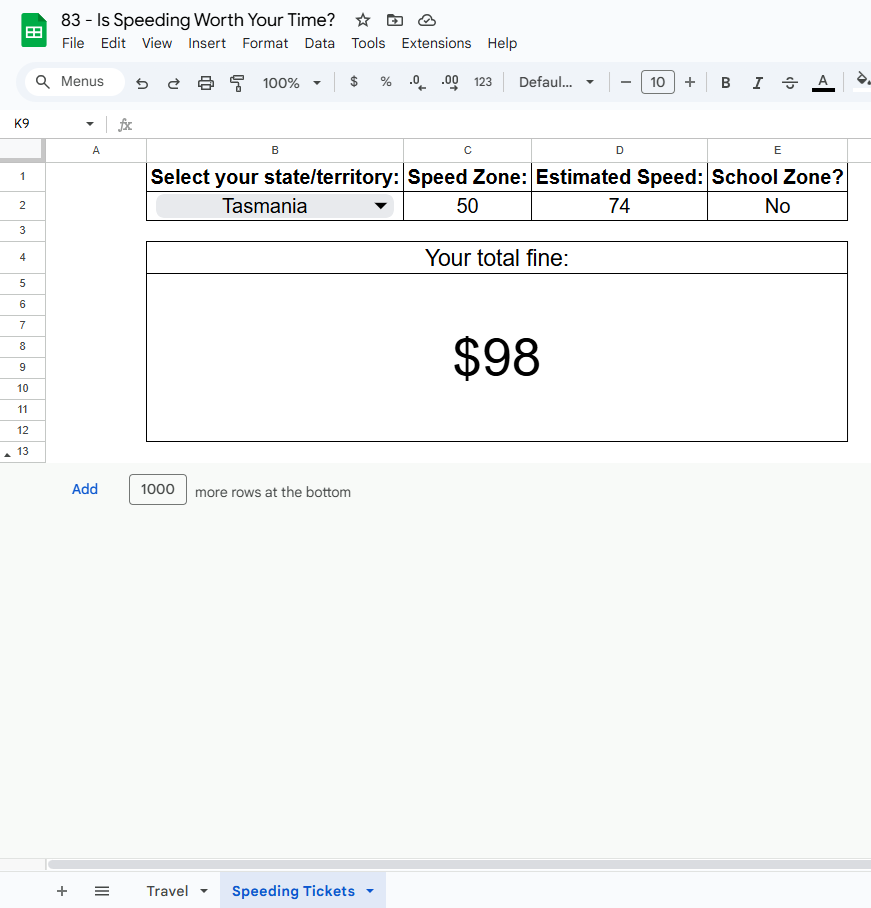
After you look up some speed results in the link above, I’m going to finish this post with this last passage, and use a string of literal and rhetorical questions to assist in reframing this approach to the cost of speeding and whether it’s actually worth your time.
What is your hourly wage? What do you feel like your hour is worth to you? From what you found in that ‘Speeding Tickets’ sheet, what was the lowest speeding ticket value (not including demerit points) in your state? Is an hour of your time worth the amount of the speeding ticket? What about 30 minutes? 1 minute? I’m going to put it down to experience, but once I reframed that idea of speeding around my value of time (…and not about the lives of others, go figure) it really got me to consider how people might need a shift in their framing on pressing on the accelerator. If your hourly wage matches that speeding ticket, then you should technically be indifferent between receiving that speeding ticket or not, and you shouldn’t care about that speeding ticket if your hourly wage exceeds the value.
 James Miller CV